

Technical note
How Terahertz Thickness Measurement Works
Terahertz thickness measurement uses short electromagnetic pulses to resolve internal layers and calculate thickness without contact or destructive testing.
The need for non-contact thickness measurement
Thickness measurement is routine across coatings, polymers, composites, and advanced materials work.
Conventional techniques often require physical contact with the sample or destructive sample preparation, which is a problem for delicate surfaces and for any multilayer stack where the layers of interest sit underneath the outer one.
Measuring thickness from time delay
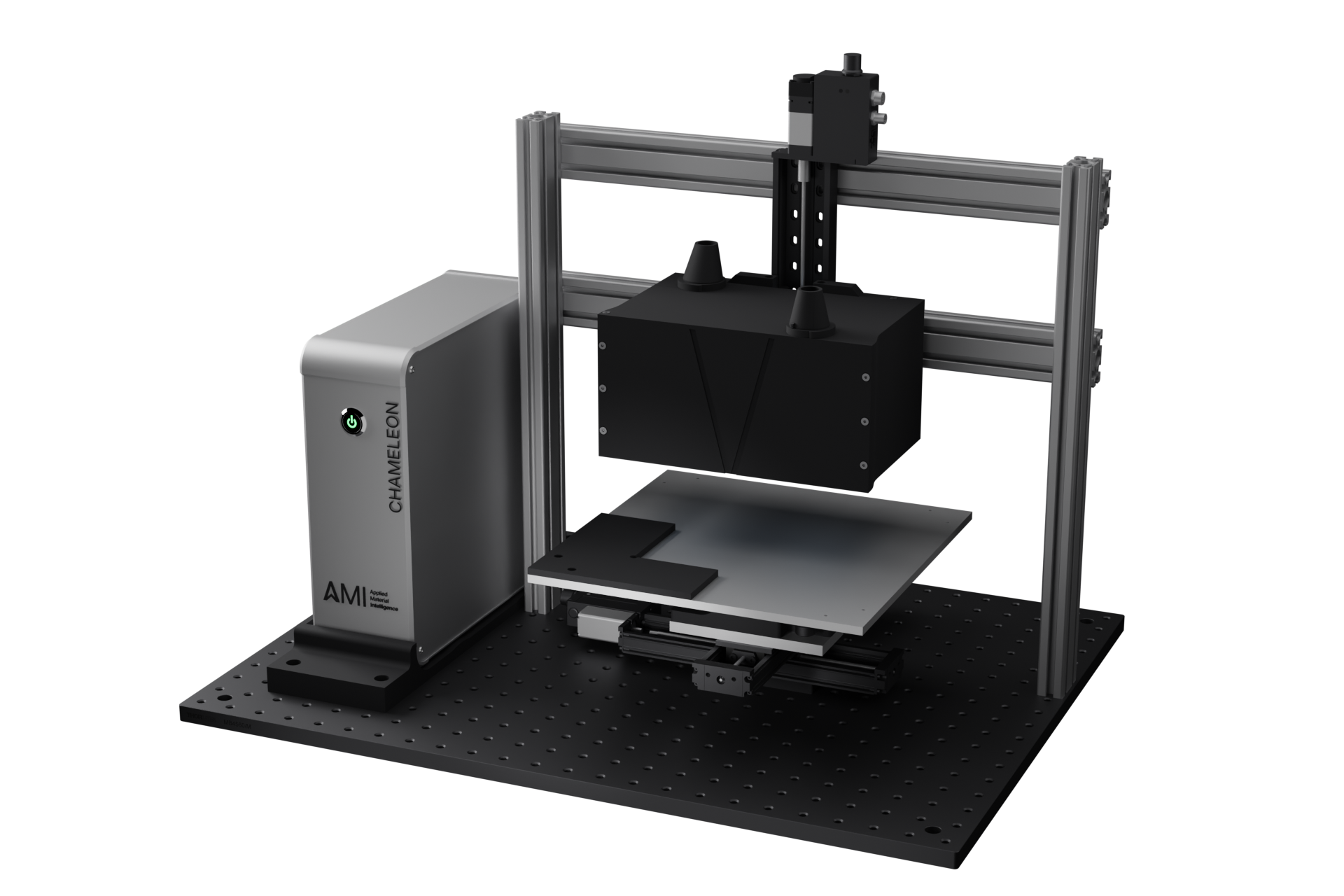
Chameleon generates terahertz signals via photoconductive antennas in an optoelectronic architecture, with a broadband continuous light source and a controlled optical delay. The instrument is built as a fully fiber-based platform, more compact and stable than conventional terahertz time-domain systems that rely on short pulsed lasers and free-space optics.
Each reflected signal comes from a specific interface inside the material. The time delays between those reflections give the distance between interfaces, and once the refractive index of each layer is known, those distances convert into thicknesses.
From signal to thickness
- 1
Emit
The photoconductive antenna sends a terahertz pulse into the sample.
- 2
Reflect
Each interface between layers reflects part of the pulse back toward the detector.
- 3
Detect
The detector records arrival time and amplitude for every returned pulse.
- 4
Calculate
Time delays between reflections, combined with the refractive index of each layer, give the thickness.
Advantages of terahertz measurement
Terahertz systems offer several advantages compared to conventional methods.
Measure without touching the sample surface.
Inspect internal structures without cutting or damaging the material.
Resolve internal interfaces in multilayer materials.
Well suited for controlled laboratory and research workflows.
When terahertz is the right tool
Terahertz reflects off metal substrates, which makes it well-suited to coatings on steel, aluminium, and galvanized panels. The signal reflects cleanly off the substrate, defining the coating’s lower boundary.
The same property means terahertz cannot measure through a metallic top layer or measure the thickness of a metal sheet itself. For those, ultrasound or eddy-current methods remain the right tools.