Application
Defect detection
See wrinkles, delamination, and voids below the surface of glass-fibre and other non-conductive composite parts, without contact and without couplant.
The challenge
The defects that matter sit below the surface
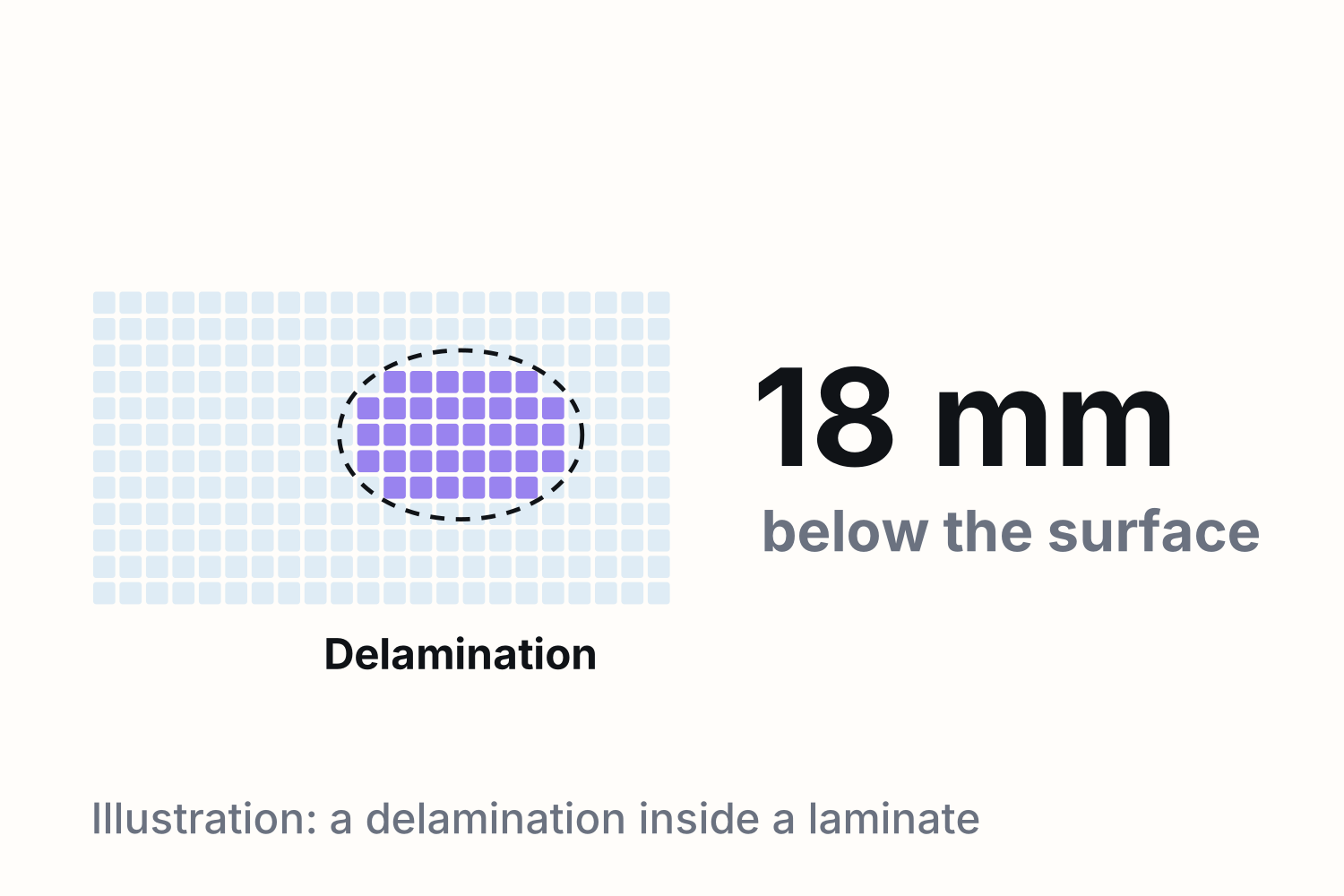
In composite structures, the defects that matter to performance (wrinkles in the layup, delamination between plies, internal voids) sit below the surface, where visible inspection cannot reach them. Destructive sectioning answers one location at a time and ends the part. You need a way to see inside the part without cutting it open.
See inside a glass-fibre layup without cutting it open
Chameleon images internal features of non-conductive composites from the reflected terahertz light, resolving fibre wrinkles and ply separations as a spatially resolved view you can evaluate against acceptance criteria. The signal reflects at every interface where the refractive index changes, which is the same mechanism described in how terahertz thickness measurement works.
Terahertz is non-contact and needs no coupling medium, so a dry, uncoupled scan can be run on a finished surface without preparation. That is the practical difference from contact methods, rather than any advantage in depth. For thick laminates and deep inspection, ultrasound reaches further and remains the appropriate method.
The technique applies to glass-fibre laminates, foams, sandwich cores, and adhesive bondlines. It does not apply to carbon fibre: carbon is electrically conductive and reflects terahertz at the surface, so a CFRP layup cannot be imaged through. Where a part combines both, only the non-conductive sections are accessible. The same substrate logic governs coating thickness measurement and multilayer analysis, and the instrument itself is described on the Chameleon product page.
What it changes in practice
Glass-fibre, foam, and sandwich structures resolved without cutting the part.
Layup defects and ply separations made visible in place.
Dry scanning on a finished surface, with 2D imagery suitable for technical review.
Wrinkles and ply separations resolved through a glass-fibre layup
In wind blade work with Siemens Gamesa, Chameleon was used to detect wrinkles in the glass-fibre layup non-destructively. The reflected terahertz light resolved the location and depth of features, turning hidden manufacturing defects into measurable, reviewable results.