Application
Thickness measurement
Resolve coating and film thickness from reflected terahertz light, non-contact and non-destructive, on metal and non-metal substrates alike.
The challenge
When a contact gauge can’t be trusted
Thickness sounds like a solved problem until the part is curved, the coating is soft, or a contact gauge cannot be trusted near a critical edge. You need a thickness reading you can act on: at the point that matters, with confidence in the number, and without leaving a mark on the surface.
Thickness without contact, on metallic and non-metallic substrates
Chameleon resolves coating or film thickness from reflected terahertz light, in a non-contact and non-destructive way, on metallic and non-metallic substrates alike. A metal substrate is the strongest case: it reflects the pulse almost completely, giving a clean boundary at the base of the coating. Non-metallic substrates return a weaker but usable reflection wherever the refractive index changes across the interface. Substrates that are index-matched to the coating, or strongly absorbing at terahertz frequencies, will not produce a usable boundary.
The same physical principle that makes multilayer analysis possible also delivers precise single-boundary thickness, with no compression of the coating and no surface damage at the measurement point. The signal path is described in how terahertz thickness measurement works, and the instrument in the Chameleon product page.
What it changes in practice
No surface contact, no gauge pressure, no marking.
The number does not depend on operator technique.
Each value is anchored to a known location, not an average.
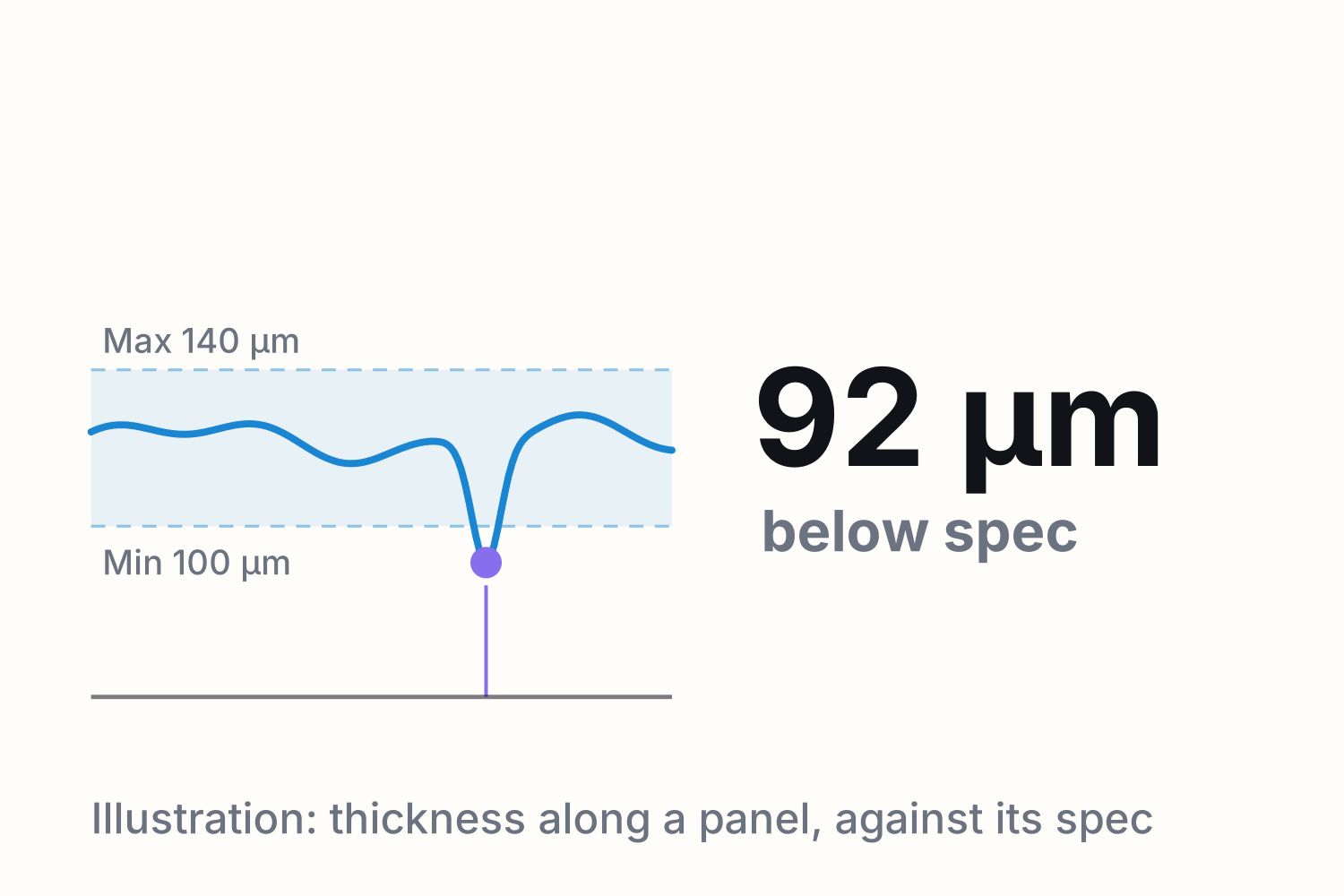
Stable single-point thickness, anchored to a known location
Stable single-point thickness values tied to a known location on the sample, repeatable across operators and measurement sessions. The same setup extends naturally into mapped acquisition when you need to see how thickness varies across an area.